
Somewhere in 2026, every Head of L&D is having the same conversation with their CEO. It usually starts with a number. “We spent £4 million on learning this year. What did we get for it?”
The honest answer, if you are being honest, is: completions. Hours logged. Modules consumed. Maybe a satisfaction score that hovers reassuringly above four out of five.
That is not what the CEO is asking. The CEO is asking about competence. They want to know whether the team can actually do the work. Whether the new shipping line manager closes the deal. Whether the field exec in the supermarket finishes the visit in twenty-three minutes. Whether the auditor catches the thing the regulator would have flagged.
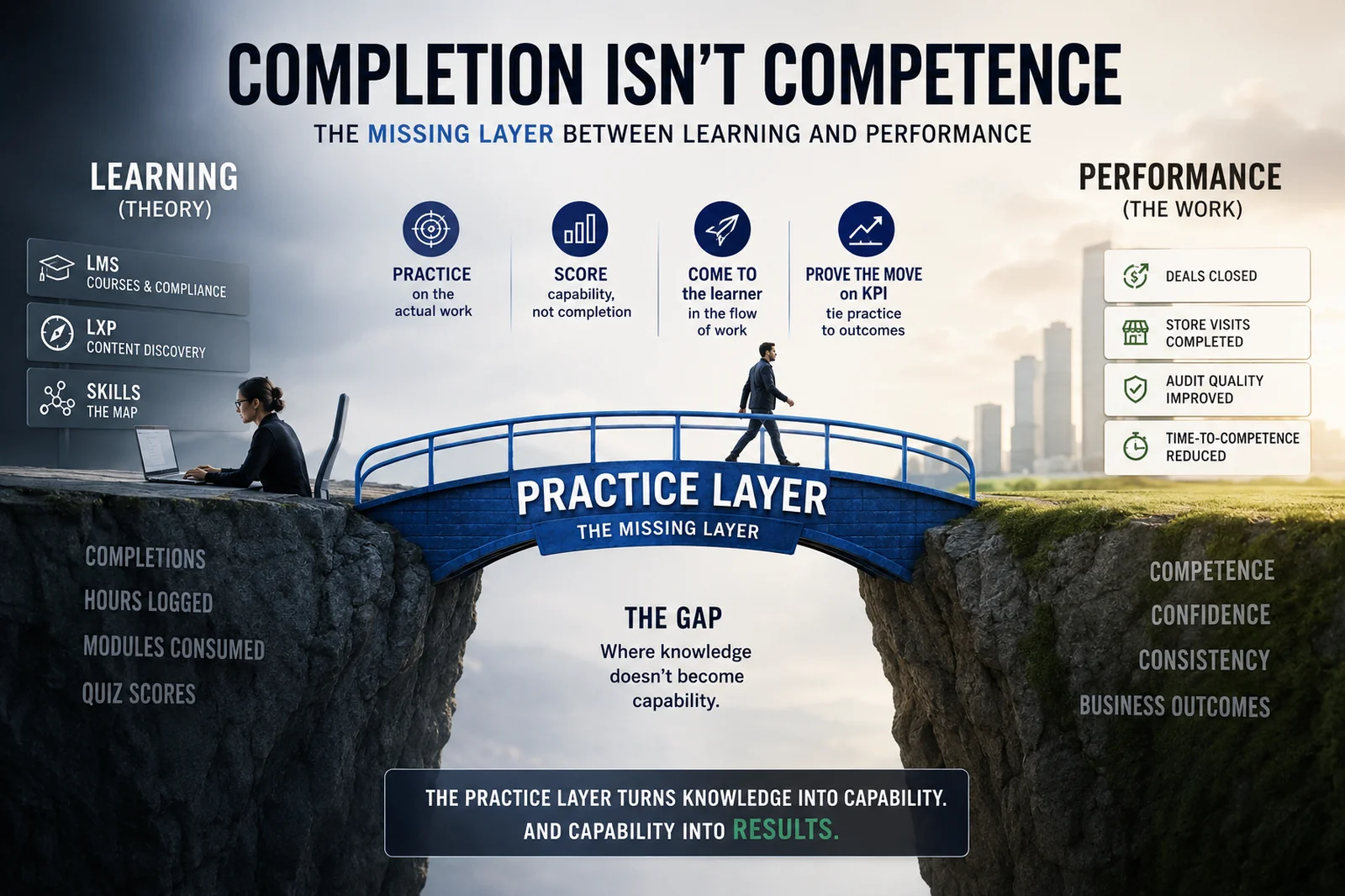
L&D, in 2026, is sitting on a quiet problem. We have a stack that proves completion. We do not have a stack that proves competence. The gap between those two is where every awkward CEO conversation lives.
What is in the L&D stack today
The modern L&D stack has three accepted layers.
The Learning Management System (Cornerstone, Docebo, SAP SuccessFactors, Rise Up) handles theory: courses, compliance, certifications. The Learning Experience layer (Degreed, EdCast, 360Learning) handles content discovery. The skills layer (Workday Skills, Lightcast, internal taxonomies) handles the map.
None of these layers handles practice.
This is not a criticism. It is a category gap. The LMS was never designed to make people good at the work. It was designed to assign content, track engagement, and produce a passing score on a quiz. That is why every L&D leader, when pressed, admits the same thing: the LMS is downstream of training and upstream of performance, and the bit in the middle, the actual practice that turns knowledge into capability, is invisible to the stack.
We have been papering over this for years. With instructor-led workshops. With role-play sessions that do not scale. With coaching that hits the top of the org and never reaches the field. With “managers as coaches” programmes that everyone agrees sound great and nobody operates well.
The gap stays open.
Why the gap matters now
Three things changed at once.
First, the executive committee started asking proof questions. Post-pandemic training spend doubled in most enterprises. The bill came due, and finance teams started asking what came back. “Completion” stopped being an acceptable answer in 2024. By 2026, it is an embarrassing one.
Second, AI mandates landed on every L&D leader’s desk. “What are we doing with AI?” became a question with a deadline, usually attached to a board review. L&D leaders who do not answer that question this year will answer to someone else about it next year.
Third, the labour market compressed and got weirder. Roles change shape faster, hybrid disrupted the apprenticeship paths that used to make people good at work, and the cost of a slow ramp on a new hire crossed a threshold most CFOs are now tracking. Time-to-competence is not a soft metric anymore. It is a line on the operating plan.
These three forces converge on the same demand: prove that your learning investment translates into capable people, doing capable work, on the timeline you said. Completion was never going to answer that. The LMS is not equipped to. The LXP is not either.
We need a different layer.
Naming the gap: the Practice Layer
The Practice Layer is the part of the L&D stack that operates between learning and performance. It does four things the LMS does not.
It runs practice on the actual work. Real, contextual, simulated practice of the work that needs to be done, not multiple-choice quizzes about the work. A shipping line manager runs through a difficult customer call before the customer calls. A field exec walks through tomorrow’s store visit. An auditor pressure-tests a tricky judgement before the engagement starts. The practice is on the work, with the team’s own materials, at the moment of use.
It scores capability, not completion. The Practice Layer does not ask “did you click the button?” It asks “can you do the thing?” And it produces a signal a manager and an L&D leader can both read. Skill proficiency, not module finished.
It comes to the learner. The LMS sits and waits for the learner to log in. Most learners do not. The Practice Layer pushes into the learner’s working day, in the tools they already use, at moments tied to actual work events. It treats attention as the constraint it is.
It proves the move on KPI. Because the Practice Layer connects to the work, it can tie practice to outcomes. The deal conversion rate of the salespeople who practised versus those who did not. The store visit cadence of the field execs who used the coach versus those who did not. The audit error rate. This is the answer to the CEO question, finally, in a form a CEO can read.
Where the Practice Layer sits
It sits next to your LMS, not on top of it. Your LMS stays. Your LXP stays. Your skills framework stays. The Practice Layer fills the gap none of those was built to fill.
It is not a replacement project. It is an addition. Like the LMS in 2005, or the LXP in 2015, the Practice Layer is a new layer of the stack that becomes the obvious one in retrospect.
L&D leaders who add the Practice Layer this year do two things at once. They answer the AI mandate with a real product, not a slide. And they re-write the CEO conversation, from completion to competence, on terms they control.
L&D leaders who do not will have that conversation anyway. Just on someone else’s terms.
A note on Forge
Forge is the first Practice Layer for the enterprise. We sit next to your LMS, draw from your own materials, and run the practice that proves the move on the number that matters. We are built by the team behind Rise Up’s 600 enterprise customers, five million learners and forty-five languages, and we ship in days, not quarters.